Turn a Solved Cube Into a Pattern
A Rubik's Cube pattern is a pretty, symmetric design you make by turning a solved cube with a short list of moves. This tool shows ten of the best known ones for the 3x3 cube. Choose a design, press Play, and the cube on screen makes every turn for you. Then copy the same moves on your own cube and the design appears in your hands.
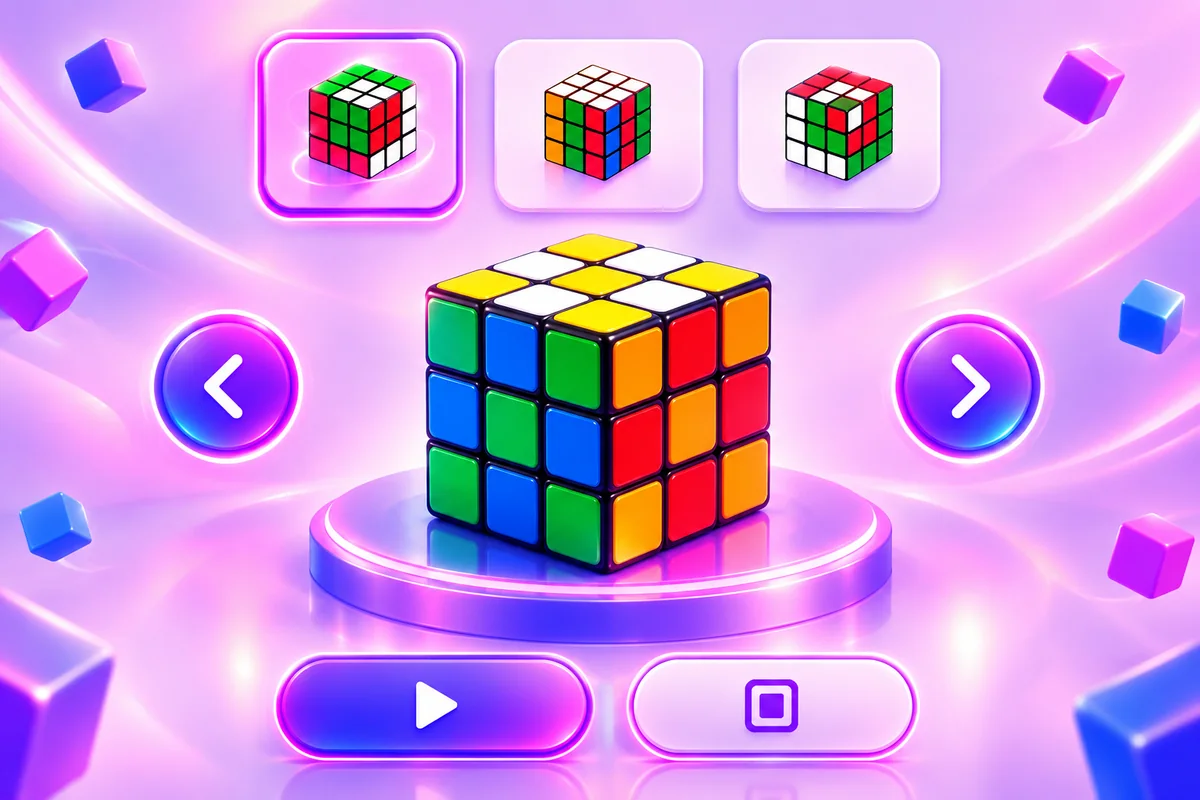
Patterns are a fun way to show off a cube, to practise reading cube notation, and to see how a few turns can change every face at once.
How to Use the Pattern Maker
- Hold your cube with white on top and green in front, and make sure it is solved.
- Tap a pattern in the row at the top. A small picture shows how it will look.
- Press Play to watch the whole pattern, or use the left and right arrows beside the cube to go one move at a time. Press Start Over to go back to the solved cube.
- Copy each move on your own cube. When the last move is done, your cube shows the pattern. The status line then gives the moves to undo it.
The 10 Patterns and Their Moves
Every list below starts from a solved cube held with white on top and green in front. The undo line is the same moves backwards, and it brings a finished pattern back to a solved cube.
Checkerboard
Every face becomes a checkerboard: the center and the four corners show one color and the four edge stickers show its opposite. It needs only six half turns, so it is the best pattern to try first.
R2 L2 U2 D2 F2 B2B2 F2 D2 U2 L2 R2Six Spots
Each face keeps its center color as a single spot inside a ring of one other color, so you get six clean spots, one on every face. It takes eight moves.
U D' R L' F B' U D'D U' B F' L R' D U'Tetris
Every face splits into three colors in chunky block shapes that many people compare to Tetris pieces. A short, eight-move pattern with a bold look.
L R F B U' D' L' R'R L D U B' F' R' L'Crosses
Each face shows a plus sign in its own center color, with the four corners in another color. It needs eleven moves.
U F B' L2 U2 L2 F' B U2 L2 UU' L2 U2 B' F L2 U2 L2 B F' U'Anaconda
Each face uses only two colors, arranged in a winding shape that gives the pattern its snake name. Fourteen moves.
L U B' U' R L' B R' F B' D R D' F'F D R' D' B F' R B' L R' U B U' L'Python
Each face uses only two colors, and the top and bottom faces show bold stripes. Fourteen moves, and a good one for practising longer move lists.
F2 R' B' U R' L F' L F' B D' R B L2L2 B' R' D B' F L' F L' R U' B R F2Cube in a Cube
Each face shows a 2x2 block of one color wrapped in an L-shaped border of another color, so a smaller cube seems to sit in the corner of the big one. Fifteen moves.
F L F U' R U F2 L2 U' L' B D' B' L2 UU' L2 B D B' L U L2 F2 U' R' U F' L' F'Stripes
The top and bottom faces stay one solid color, and each of the four side faces turns into three vertical stripes. Seventeen moves.
F U F R L2 B D' R D2 L D' B R2 L F U FF' U' F' L' R2 B' D L' D2 R' D B' L2 R' F' U' F'Cube in a Cube in a Cube
Every face shows one corner sticker, an L of three stickers and an outer L of five stickers, which makes three cubes look nested inside each other. Eighteen moves.
U' L' U' F' R2 B' R F U B2 U B' L U' F U R F'F R' U' F' U L' B U' B2 U' F' R' B R2 F U L USuperflip
All twelve edge pieces are flipped in place while the corners and centers stay solved. It needs 20 face turns at the very least, which is the largest number of turns any cube position is proven to need.
U R2 F B R B2 R U2 L B2 R U' D' R2 F R' L B2 U2 F2F2 U2 B2 L' R F' R2 D U R' B2 L' U2 R' B2 R' B' F' R2 U'How to Read the Moves
Each letter is a face of the cube: U is Up, D is Down, L is Left, R is Right, F is Front and B is Back. A letter on its own, such as R, is a clockwise quarter turn when you look straight at that face. A letter with an apostrophe, such as R', is a counter-clockwise quarter turn. A letter with a 2, such as F2, is a half turn. While the cube plays, the line under the buttons also names the face by its color, so you always know which side to turn.
Tips for Getting a Clean Pattern
Start from a solved cube with the same orientation every time. Go slowly and use the arrows beside the cube to check each move, because one wrong turn changes the whole result. If you slip, turn your cube back to solved using the undo line, or paint it into the Cube Solver and follow the solution. A cube with different sticker colors still makes the same shapes, only in your own colors.